
Paterson Previous Residents by Era
One Paterson address can leave several kinds of evidence. Recorded deeds follow ownership transfers, while directory street pages and census schedules describe households at selected points in time. The sources overlap imperfectly, so gaps are evidence of missing coverage, not proof that nobody lived there. Begin with the newest record that identifies the parcel, then select the next source by the period you need to reach.
| Source | Years It Covers | Where Held | What It Shows |
|---|---|---|---|
| PRESS deeds and mortgages | Images from 1989; broader indexed records from 2000 | Passaic County Clerk online and Registry counter | Transfers, parties, recorded dates, instruments, and legal descriptions |
| PCHS Paterson directories | Current shelf 1915-1968 with gaps; older guide 1859-1962 | Passaic County Historical Society, Lambert Castle | Street-page address and occupant snapshots |
| Federal census | 1790-1950 public release range | NARA and approved databases | Household and address or ward context on the census date |
| Sanborn maps | 1887, 1899, and 1915 Paterson runs | Library of Congress online | Structure, use, street, and parcel context, not ordinary resident names |
| PCHS church, cemetery, and obituary holdings | Named series vary, with some material from the 1820s onward | PCHS collections and online resources | Family relationships, burials, events, and local-news leads |
For a recent transfer, PRESS is usually the first stop. For a person who lived at an address decades ago, use the closest available pink street-page directory, then compare a census and a map. The New Jersey State Archives marriage database can add a family-history lead for 1848 through 1900, but it is not an address directory.
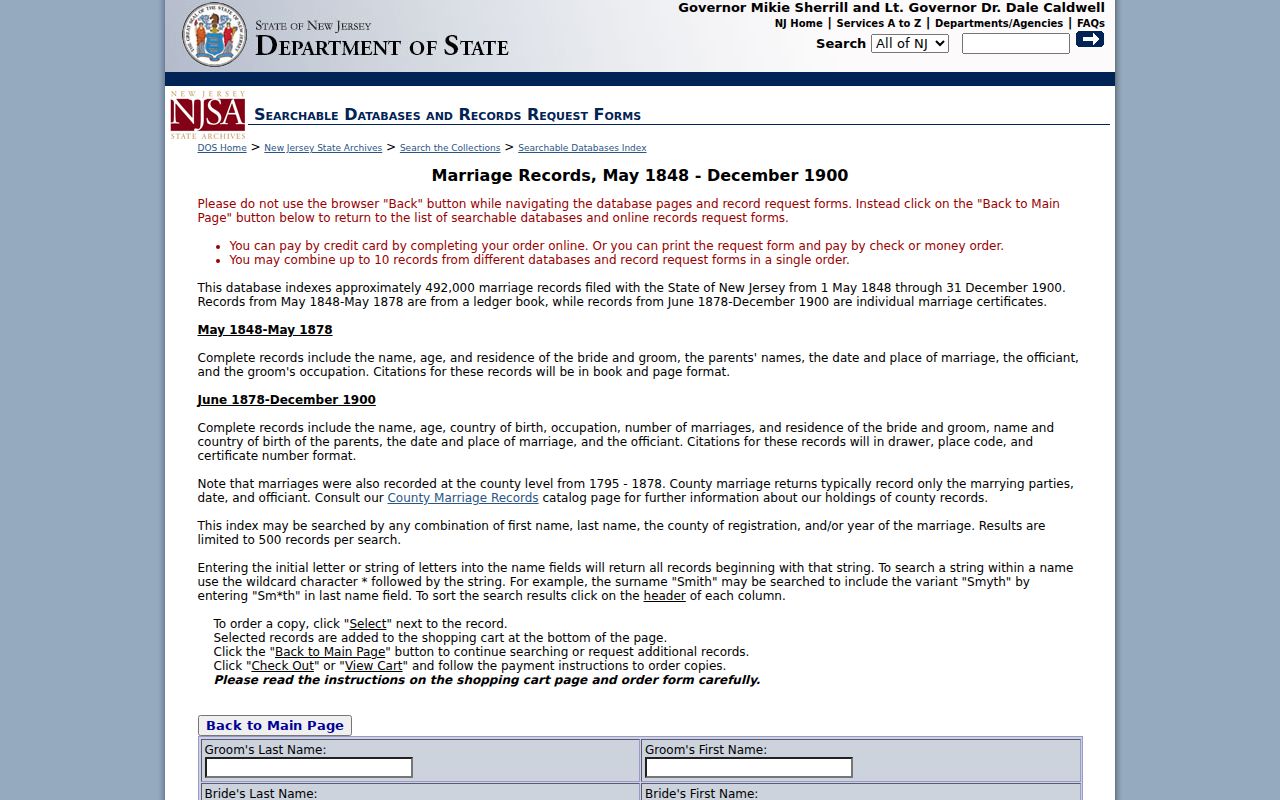
Marriage-index fields can help reconcile names, relatives, and a date after an address trail identifies the correct household.
Build a Paterson Previous Residents Worksheet
Before searching backward, make a simple address worksheet. Copy the current street number and name, municipality, block, lot, PIN, legal description, current tax owner, mailing address, deed book and page, and instrument number when each is available. A current street number alone is a weak historic key. The legal description and parcel identifiers are more likely to connect a record when an old map uses another street name or a different numbering pattern.
Start at the official Passaic County Board of Taxation entry page, then compare the address in the county GIS parcel service. GIS can show PAMS_PIN, block, lot, property location, owner, ZIP, deed fields, and building context. The polygon is planning-grade data, not a survey, and a mailing address is not proof of who occupied the parcel.
When a number seems to change, do not guess an equivalence. Use a filed map, deed, Sanborn sheet, municipal planning record, or neighboring parcel geometry to support it. The research did not locate an official citywide Paterson renumbering table, so any proposed old-to-new match should remain an inference until a record connects the two.
Note: Keep the source URL and record date beside every worksheet entry so later matches can be checked.
Trace Paterson Deeds Backward in PRESS
The Passaic County Public Records Electronic Search System, or PRESS, is the online sale-history layer. Its Name tab requires a last name and allows an optional first name. Other routes use document type and date, block and lot, or an instrument number. For an address trail, search the current owner as a grantee and compare the result to the parcel block, lot, and legal description before treating it as the same property.
- Find the present parcel in the tax and GIS sources, then copy the block, lot, owner, legal description, and any deed reference to the worksheet.
- In PRESS, search the current owner as grantee near the apparent acquisition date, or use the block-and-lot route when the parcel keys are known.
- Record the instrument number, recording date, document type, grantor, grantee, consideration if displayed, book or page, and image availability.
- Search the seller from that deed as a prior grantee for the same block, lot, or legal description, then repeat the comparison for each transfer.
- When the online run ends or the legal description changes, use the Registry counter, archived books or microfilm, or a title-searcher rather than filling the gap with a name match.
- Grantor
- The party transferring an interest in a recorded instrument, commonly the seller on a deed.
- Grantee
- The party receiving that interest, commonly the buyer on a deed.
- Chain of title
- The sequence of recorded transfers used to connect one property interest to an earlier one.
- Legal description
- The deed's parcel description, such as lot and block information, which can remain more stable than a street address.
The County Clerk does not perform title searches, and surveys are not recorded by the Clerk. A deed chain is therefore a record trail, not a legal conclusion about title or occupancy.
Paterson Previous Residents Online Cutoffs
PRESS has layered online coverage. The county describes deed and mortgage images from January 1, 1989 forward, while broader indexed property documents are described from 2000. The portal archive itself states a general-records date of December 1, 2000 to the present, with additional back-file conversion still in progress. Keep those scopes separate rather than treating one date as a universal cutoff.
Online searching is free and includes index access and first-page viewing. The County Clerk says images and index data are uploaded daily, but it also warns that accuracy is not guaranteed and that PRESS is not a title search. Try spelling variants, preserve the instrument number, and use the Registry Division when a needed image or older file is not online. Registry contact is 973-881-4777 at the Hamilton Street record-room complex.
The county's Property Fraud Warning System is another limited tool. Its free alert can be followed by an instrument-number search in PRESS. An alert calls for review of the recorded document; it does not by itself establish a false transfer.
Paterson Directories Fill Address Gaps
The Passaic County Historical Society holds the strongest local run for past residents. Its current holdings list Paterson directories for 1915-20, 1922, 1925-50, 1952, 1954, 1956, 1958, 1960, 1962, 1964, and 1968. The breaks are real. The older directory guide identifies Paterson material from 1859 through 1962 and warns that pre-1890 volumes are fragile, so the current holdings list should control a planned visit.
PCHS describes pink street pages that connect a named street and house number with occupants. Search the closest available year, then use the alphabetical portion to look for a moved address, a spouse, or a business listing. A directory records publisher research at a point in time, not a complete occupancy census. The Paterson Directory Book has the collection-level context for reading those volumes.
Paterson Suburban directories from 1956-61 are a separate selected run for surrounding communities. Paterson itself is not included in that suburban title, so do not substitute it for a missing Paterson year.
Pair Paterson Past Residents With Census
After locating an address in a street-page directory, compare it with the nearest available 1920, 1930, or 1940 federal census schedule. The federal public range reaches 1950 under the 72-year release rule. A census supplies a dated household view, while the directory offers an address-oriented snapshot. Names, ward terms, and street labels may vary, so use age, relatives, occupation clues, and the block or street context together.
- Choose the nearest directory year that includes the Paterson street page.
- Copy the address, occupant spelling, and any qualifying directory detail to the worksheet.
- Check the closest public census year for a household that fits the street or ward and the known names.
- Return to another directory year before and after the census to test whether the household remained, moved, or changed.
- Use deeds, obituaries, probate, and State Archives records to resolve only the conflicts supported by the documents.
New Jersey state census material at the Archives includes schedules from 1855 through 1915, with incomplete early coverage and indexed references for 1885, 1905, and 1915. That makes a state schedule a useful additional check when federal and directory years leave a gap.
Note: A matching surname is not enough; tie it to the address, household, and period before merging records.
Sanborn Maps Place Paterson Addresses
Sanborn fire-insurance maps answer a different question from the previous residents trail: what stood at the address at a given time. The Library of Congress has Paterson runs for 1887, 1899, and 1915. The 1887 set has 58 sheets and 28 bound double-page plates; the 1899 and 1915 runs include multiple volumes. A sheet can show a building footprint, use, material, hazard notation, and street name, but it does not name ordinary occupants.
Use the 1887 Paterson Sanborn gallery with a deed or directory. It can distinguish a place that was a dwelling from one that was a mill, store, vacant lot, or a differently configured structure. It cannot establish who lived there, so pair it with an address-keyed source.
Paterson Previous Residents Research Help
When the online and shelf sources do not connect, PCHS can provide a local research escalation. Its collections include more than 100,000 family group sheets, compiled family files, histories, church and cemetery material, school and association lists, newspapers, and local-event records. A church, cemetery, or obituary lead may connect an old address to relatives, an estate, or an executor, but it still needs to be matched to the right household.
PCHS research services list written requests, mail research beginning at $25 for one hour and up to ten photocopy pages, later hourly rates, postage, and a typical four-to-six-week result time. A short email question to library@lambertcastle.org may receive a brief response. Call before visiting Lambert Castle at 3 Valley Road, Paterson, NJ 07503, because appointment and closure conditions can apply.
The New Jersey State Archives research center supplies a second historical access channel for statewide and older material.
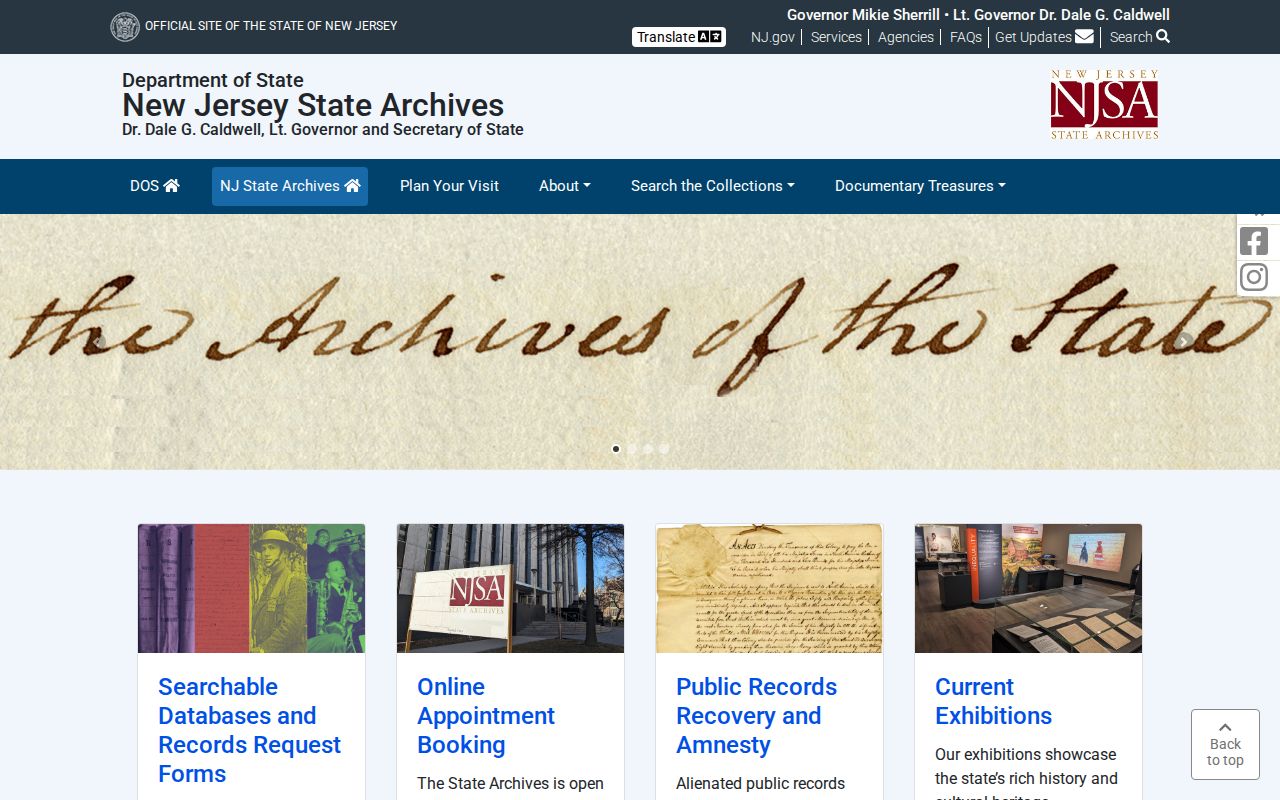
The State Archives is useful when a Paterson address trail needs census, vital, land, estate, or court-related historical context beyond the local directory shelf.
Paterson Past Residents Require Care
Past-resident research is suited to family history, estate questions, and personal house history. A recorded deed does not prove that a named owner lived at the property, and a historical directory should not be used to track a living person. Keep the work focused on the documented address and period, and do not contact or harass anyone based on an old record trail.
Older vital records have separate access rules. New Jersey generally opens genealogy copies after 80 years for births, 50 years for marriages, and 40 years for deaths, while certified copies depend on eligibility and proof. Use the appropriate custodian rather than assuming that an index entry makes the full record open.
For a genealogy request or a custody question, consult the State Archives genealogical collections information before choosing a form or a repository.
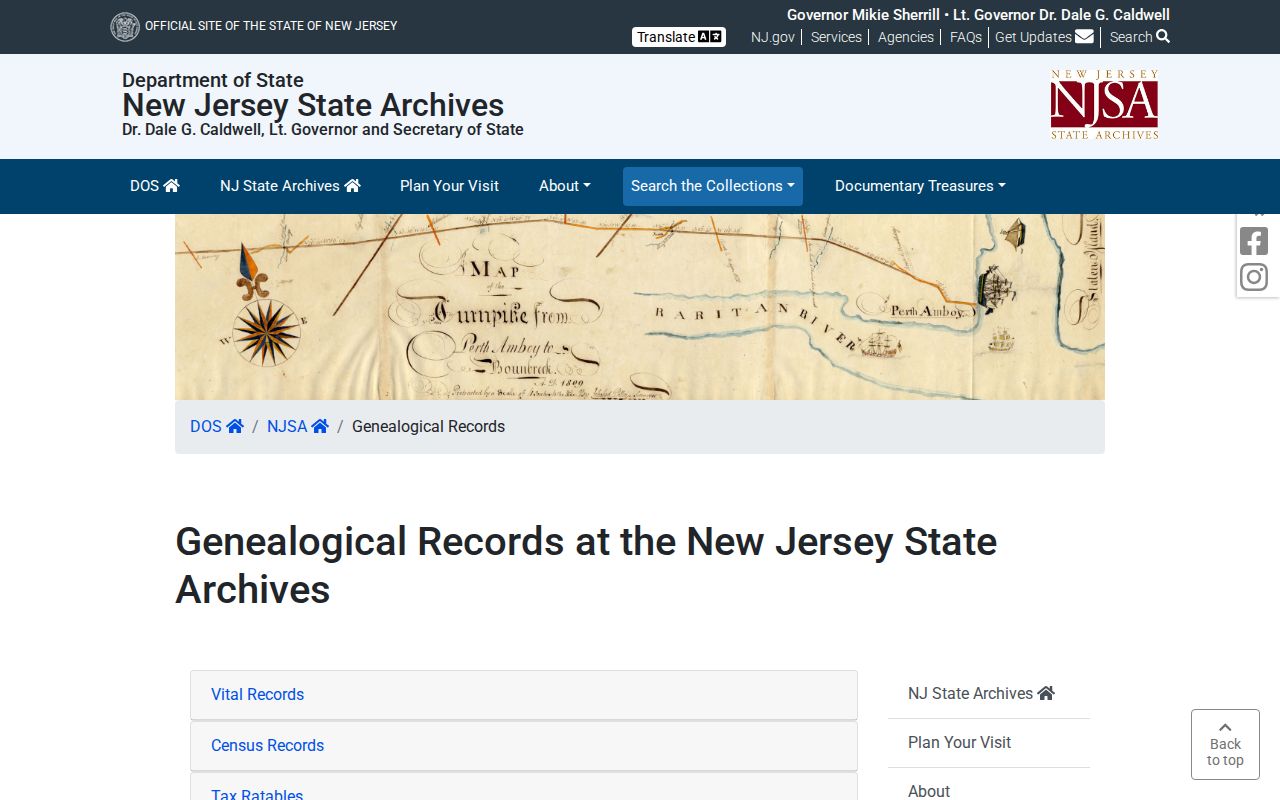
The collections guidance helps separate a historical index or informational genealogy path from a current restricted record request.